NewOur preprint, Identifiability of metabolic resilience from sparse longitudinal metabolomics, is now available on bioRxiv. The study asks what can, and cannot, be inferred about gut metabolic resilience from sparse observations.
I like asking biological questions that do not fit neatly into one box.
Javad Aminian
I’m a PhD candidate in Computational Biology and Biomathematics at UC Berkeley, where I work at the intersection of computational biology, systems science, and machine learning. I build models and learning systems to understand how biological systems organize, adapt, and respond, and, importantly, how we can turn that understanding into better decisions.
My work brings together different computational tools, optimization, and AI to tackle biological problems from multiple angles. I’m especially interested in what happens when we stop treating biology as a collection of isolated pieces and instead try to understand the rules connecting them.
I also enjoy borrowing ideas from places that, at first glance, seem far away from biology. Decision theory and microeconomics, for example, offer surprisingly useful ways to think about biological trade-offs, uncertainty, and choice. Teaching Microeconomic Analysis for Business Decisions at Berkeley’s Haas School of Business gave me another perspective on how these ideas can sharpen the questions we ask in biology.
In short: I like building things, connecting ideas, and asking “what if?”, especially when the answer leads somewhere unexpected.

Updates
Selected publications, presentations, and research milestones.
TalkOur work, Inferring gut butyrate resilience from sparse longitudinal metabolomics via effective landscapes, was accepted for an oral presentation at ISMB 2026 in Washington, DC. Turns out sparse data can still make some noise. 🎤
ConferencePresented our research at the Biophysical Society 2026 Annual Meeting in San Francisco.
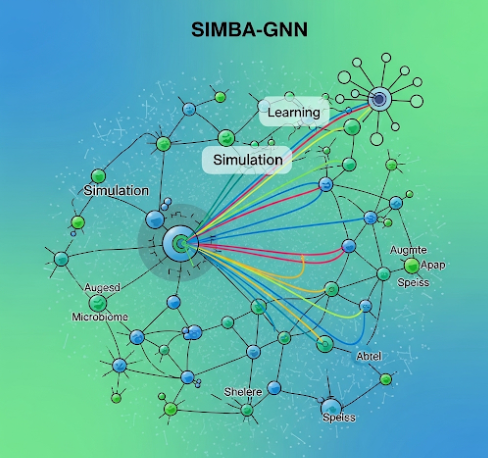
Our SIMBA-GNN paper was published in npj Systems Biology and Applications.
Our review, Systems biology and microbiome innovations for personalized diabetic retinopathy management, was published in npj Systems Biology and Applications.
Presented two works at the ICML 2025 GenBio Workshop, asking how AI can move beyond black-box predictions and make sense of the wonderfully messy world of microbial ecosystems.
ConferenceKODA was selected for publication in the Proceedings of Machine Learning Research for MLCB 2025.
Our KODA preprint is now available on bioRxiv.
Our SIMBA-GNN preprint is now available on bioRxiv.
ConferenceTwo abstracts were accepted to the Machine Learning in Computational and Systems Biology program at ISMB/ECCB 2025 in Liverpool, UK, featuring our work on LLM agents and graph learning for microbiome science.
ConferenceOur collaborative study with the UC Davis Health Eye Center, at the intersection of clinical ophthalmology and machine learning, was accepted for presentation at ARVO 2025.
Our paper, MetaBiome: a multiscale model integrating agent-based and metabolic networks to reveal spatial regulation in gut mucosal microbial communities, was published in mSystems.
The MetaBiome preprint is now available on bioRxiv.
Our paper on growth–yield trade-offs and multispecies metabolic interactions in the gut biofilm niche was published in BMC Microbiology.
Our study, Metabolic interactions shape emergent biofilm structures in a conceptual model of gut mucosal bacterial communities, was published in npj Biofilms and Microbiomes.
Our review, Synthetic biology tools for environmental protection, was published in Biotechnology Advances.
talkPresented Ecology of cooperation and conflict in microbial communities using mathematical modeling at the JBIMS Spring Workshop at UC Berkeley.
Our review, Gut-on-a-chip models for dissecting the gut microbiology and physiology, was published in APL Bioengineering.
Our paper on computational paradigms for studying gut microbial metabolism in cardiovascular disease was published in Frontiers in Cardiovascular Medicine.
Joined the Molecular Cell Biomechanics Laboratory at UC Berkeley as a PhD researcher in computational biology.
Selected work
Research
I develop computational frameworks that connect biological mechanism with prediction and decision-making, spanning multiscale modeling, graph machine learning, scientific AI, and optimization.
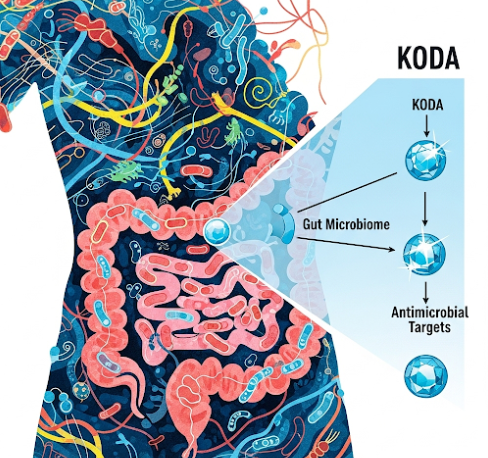
KODA: An agentic framework for KEGG orthology-driven discovery of antimicrobial drug targets in gut microbiome
Advancing biological discovery by targeting the gut microbiome to identify potential antimicrobial drug targets using LLMs and knowledge graphs. A scalable tool to streamline hypothesis generation and enhance data-driven microbiology research.

Synthetic biology tools for environmental protection
What we know from the applications of synthetic biology for environmental protection?